Snow Operations and Semi Trucks: My Favorite Part of Winter
If you’re reading this, I’m probably somewhere in the middle of my second 12-hour shift of the week, cold and tired. But this blog is going out just like I planned, because snow or no snow, we stick to the plan.
Let’s talk about snow. At the airport, snow is a big deal. It’s not just “grab a shovel and let’s see what happens.” Snow ops is a full-scale, highly choreographed production. Every time it snows, the airport activates a whole system of people, equipment, and plans that are all designed to keep the airfield safe and moving.
And believe it or not, I love it.
Not cold. I hate cold. But snow ops? I’m all in.
Year 1: My Start as a Winter Seasonal
This all started a few years ago when I got hired on as a Winter Seasonal, basically, part of the airport’s temporary snow crew. I joined a little team that rolled in when the flakes started falling and didn’t go home until the pavement was clear.
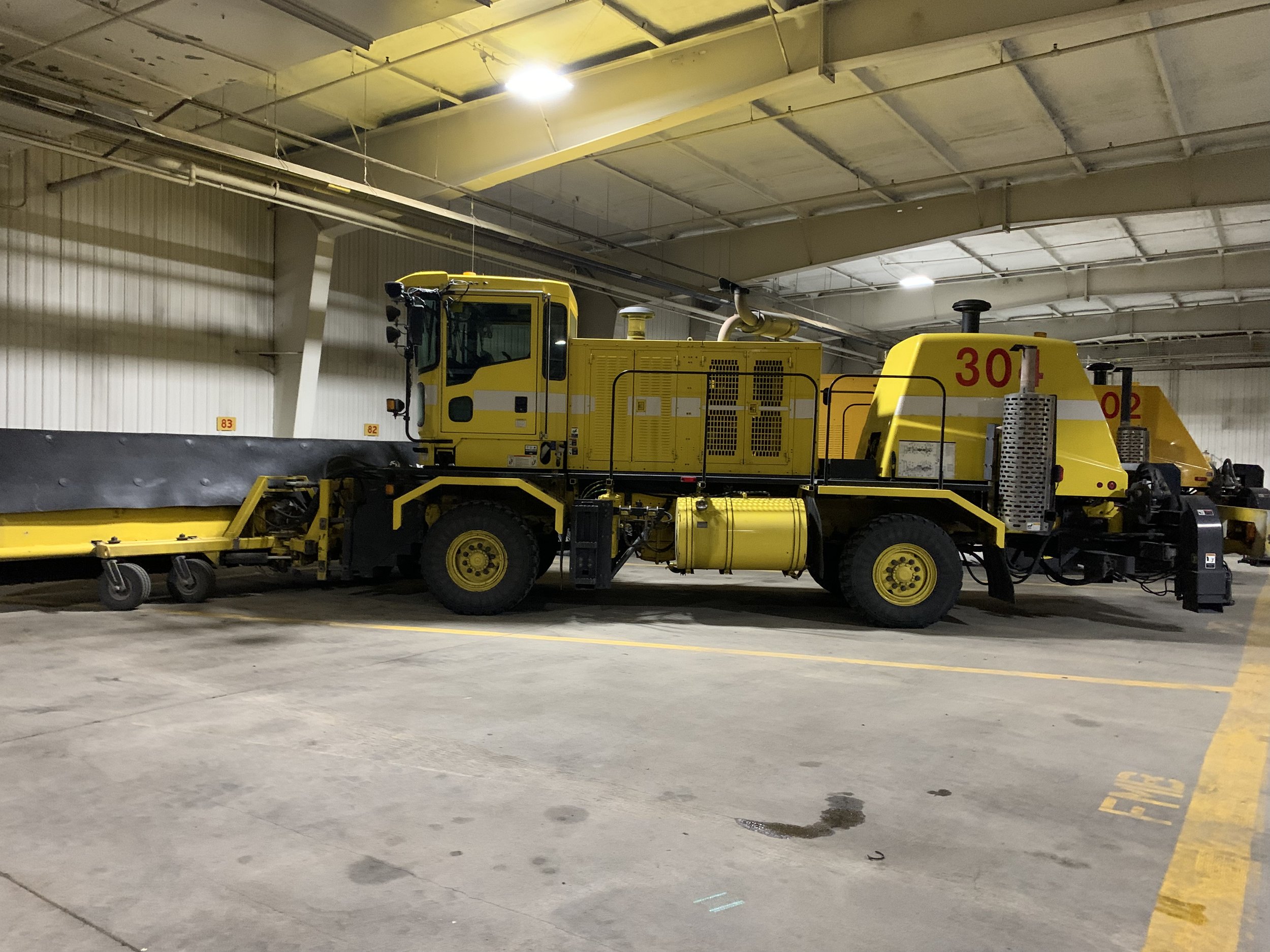
They handed me keys to a front-mount broom, a massive truck with a huge rotating brush right on the front. That’s all it does. It doesn’t push the snow to the side like a plow. It sweeps it off the surface and throws it into the wind.
The brooms are part of “the pack”, a crew of plows and brooms that move together in tight formation to clear the ramp. (The ramp is the big area, around the terminal, where planes park at the gates, passengers load and unload, and a million bags are getting tossed in every direction, pulled around, and taken to belts to give to passengers.)
It’s a tight space, full of aircraft, support vehicles, cones, and moving parts, and we have to clear it during active operations. You’re constantly watching for planes, stopping, adjusting routes, trying not to broom snow into a jet engine. Easy stuff.
Looking back, it was one of the most adrenaline-filled and chaotic ways to fall in love with this job.
Year 2: MTE Life and the Runway Team
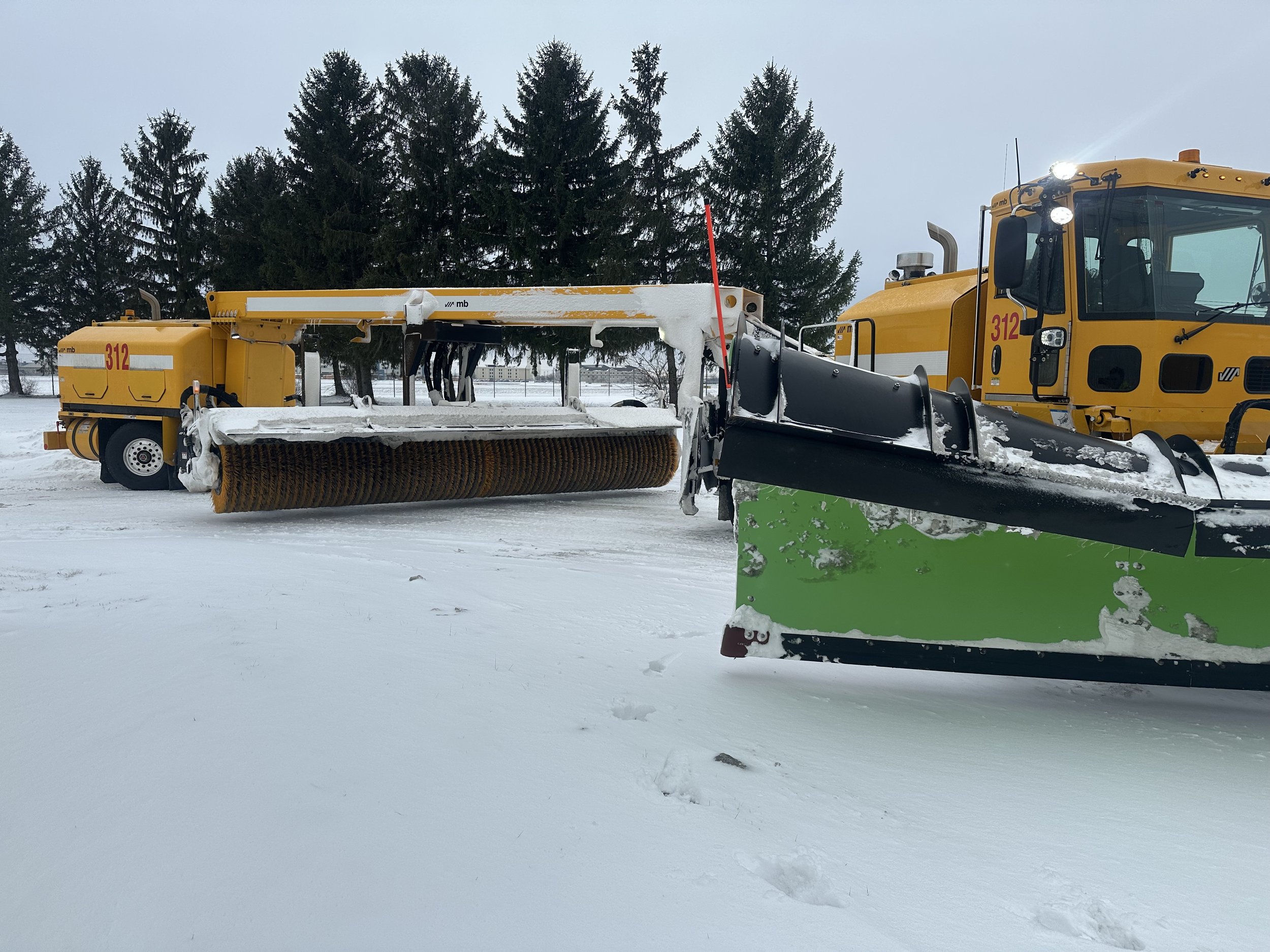
The next year, I moved up to something called an MTE, short for Multi-Tasking Equipment.
An MTE is a full-size semi-truck that has:
A plow on the front
A broom underneath
And a blower at the back, not a snowblower like you use on your sidewalk, but a massive air blower that clears any loose snow left behind after the broom does its thing
Also, all the wheels turn, which means the trailer follows the exact path of the front tires. It’s the most satisfying thing in the world to make a perfect corner in that thing.
That year, I was on the runway team, and I even lead the runway team most of the season.
Let’s Pause: Runway Team Basics
Runways are obviously critical. If they’re not clear, planes aren’t landing. So when we plow them, we do it with speed, precision, and a crazy level of coordination.
It’s not just me in an MTE going rogue.
The runway snow team includes:
A lead vehicle (Airport Ops, who we call Snow Boss) that calls in for clearance from the FAA Tower
Multiple plows, brooms, and blowers running in a specific pattern
A very strict on/off time to clear the runway, report it safe, and reopen it to air traffic
Constant radio communication with the tower, Snow Boss, the AFM plowing team, and everyone on the teams.
If you’ve ever watched synchronized swimming or NASCAR pit crews, it’s kind of like that, but with more diesel fumes and no audience.
Clearing a runway quickly and safely is one of the most impressive things we do as an airport, and it’s something I’ll never take for granted.
Year 3: Ramp Team Leader
Last year, I stepped into a new leadership role, ramp team lead. And let me just say, it was a whole different kind of beast.
When you’re working on a runway, the airspace is closed and no planes are moving. But on the ramp, planes and vehicles are moving. Constantly. And planes ALWAYS have right of way and vehicles, unlike us, often don’t stop or yield or check their blind spot.
So our job is to clear the ramp is large, complex, congested areas, while avoiding all aircraft, staying out of the way of deicing trucks, making sure you’re not brooming snow into a gate area, and dealing with giant piles of snow that require multiple passes to clean up.
It’s the most stressful type of snow operation. It’s also the most rewarding.
You’ve got to be quick-thinking, radio fluent, and situationally aware at all times. You’re watching jet engines, fuel trucks, cones, wings, and coworkers. You’re rerouting in real time. And you’re doing all of it in the dark, in a snowstorm, in a 40,000 lb truck.
I loved it.
Year 4: Behind the Radio — Welcome to Snow in Airport Operations
This year, I’m in a new role: Airport Operations Coordinator, which means I’m not in the trucks anymore. I’m inside. At Snow Desk, or in a pickup truck without a plow.
If you’ve never heard of Snow Desk, that’s because it’s the most behind-the-scenes part of snow ops, but honestly, it’s one of the most important.
Snow Desk: The Secretary of the Storm
Snow Desk is where everything comes together. It’s where we:
Log who is working, what equipment is being used, and which areas are being cleared
Track how long routes take and what route each driver used
Record any incidents, breakdowns, or reroutes
Monitor chemical use, snow totals, and surface conditions
Track runway open/close times and the conditions at reopening
Issue NOTAMs and FICONs, and keep everyone in the loop
And here’s the best part: Snow Desk is located in the old FAA tower, which means we get the best view of the whole airport… if it’s not snowing. Which, of course, is never when we’re up there. So in reality, we mostly get a great view of a white blur, a few blinking lights, and maybe a tail fin if we’re lucky. But hey, the potential for a good view is elite.
What’s a NOTAM?
Let’s break it down: a NOTAM is a Notice to Air Men. It’s an official alert to pilots, dispatchers, and anyone else flying into or out of our airport. Think of it like a traffic update, but way more precise (and way more critical).
We issue NOTAMs for things like:
Runway closures (“Runway 10R/28L closed due to snow removal”)
Braking action reports (“Braking action medium”)
Low visibility conditions
And a dozen other things that impact flight safety
They go out fast, get updated constantly, and are part of what keeps everyone on the same page when weather starts to move in.
What’s a FICON?
A FICON is short for Field Condition NOTAM. It’s basically a specialized type of NOTAM that tells pilots exactly what the surface conditions are on each runway, taxiway, and ramp. These are based on real-time measurements and visual inspections.
FICONs include:
Contamination type (snow, ice, slush, etc.)
Depth of that contamination
Runway condition codes (a set of three numbers representing the thirds of the runway — like 5/5/3 — that tell pilots how slick each section is)
A braking action report, if one is available
They’re essential for pilots when making decisions about landing distance, braking, and how the aircraft will handle on the ground. We send these out every time a surface changes or gets updated.
Where Do the Numbers Come From?
We don’t just guess. We use a CFME, Continuous Friction Measuring Equipment, which is basically a pickup truck with a fifth tire mounted on the back. That tire is dragged behind the truck at a constant pressure and speed, and it records the friction level of the runway surface. (The scientific term for this is: “how likely is this to feel like a Slip ‘N Slide?”)
That CFME is housed in Truck 9, which is driven by the Snow Boss, the field lead during snow ops. Snow Boss is the one out in the elements, calling shots, coordinating closures, and communicating directly with the FAA Tower and plow teams. He gives us the CFME numbers, and we log them at Snow Desk and include them in the FICON.
Snow Boss: The Storm Quarterback
Snow Desk works hand-in-hand with Snow Boss, who is the person in charge of the entire outdoor response. They:
Call closures and reopenings
Direct plow teams and reroute them if needed
Work directly with the FAA Tower to coordinate timing
Constantly relay updates back to Snow Desk so we can update logs and send out official reports
Basically, Snow Boss is the quarterback. Snow Desk is the playbook and the scoreboard.
Ramp Control: Organized Chaos with Headsets
On top of that, we also have a role called Deice Control (or Ramp Control during snow). This person is essentially an air traffic controller for the ramp. They:
Coordinate aircraft pushbacks and taxi movements
Work with airline ops and snow crews to keep traffic flowing
Ensure that aircraft can reach the deice pad and get off the ramp safely
Keep the ground operations smooth when visibility is low and tempers are high
It’s a high-pressure job that requires knowing the layout like the back of your hand, multitasking 24/7, and being able to say “hold short where you are” in a calm voice even when six planes and three plows are yelling at you on the radio.
Why I Still Love This
Snow days at the airport are long. They’re cold. They’re unpredictable.
But they’re also some of the most impressive examples of teamwork and communication I’ve ever seen.
You’ve got people who’ve been doing this for decades, working side-by-side with new hires. You’ve got giant machines moving like choreography. You’ve got decisions happening every second, and everyone has to trust each other to get it right.
I may not be in a truck anymore, but I still get a front-row seat to all of it.
And even though I still hate winter, I’ll say it again: I love snow ops.
Snow doesn’t clear itself, and that’s where we come in.
Why I’m doing this
Partly because people keep asking me, “What do you do?” and I want to be able to point to something that actually shows it.
But mostly?
Because I don’t want to forget what I’m learning.
This job is crazy. It’s complicated. It’s full of nuance. You can work here for twenty years and still not know everything. And I don’t want the lessons to slip past me just because I didn’t take five minutes to write them down.
So this is my version of capturing it.
One post at a time. One story at a time. One lesson at a time.
If you’ve ever wondered what happens behind the jet bridge, out past the taxiway lights, or behind those giant “AUTHORIZED PERSONNEL ONLY” doors… you’re in the right place.
Let’s get to work.