Driving on the Movement Area
Learning to Talk to Tower, Ground, and Everyone Else Who Keeps CMH Safe
Today I want to break it down in a way that anyone can understand, even if the closest you have ever come to an airfield is watching planes from a window seat.
Driving on the movement area is one of the most serious responsibilities we have in Airport Operations. It is not something you wing. It is communication, focus, and teamwork.
Movement Area vs Non Movement Area
What That Actually Means
Before you ever touch a radio, you need to understand the basic layout of an airport.
Non Movement Area
This is anywhere on the airfield where you do not need approval from air traffic control to drive. Ramps. Some aprons. Some service roads. These areas belong to the airport, not the tower. You still need training. You still need awareness. But you do not need permission from air traffic control to drive in these areas.
Movement Area
This is the controlled portion of the airfield. All runways. All taxiways. Some apron areas depending on the airport. At CMH, if it is a taxiway or a runway, it is a movement area and you must be in contact with ground control or tower depending on what you are doing.
A movement area is exactly what it sounds like. It is where airplanes move, and because airplanes do not stop quickly or turn easily, every movement in this area must be controlled.
The Movement Non Movement Line
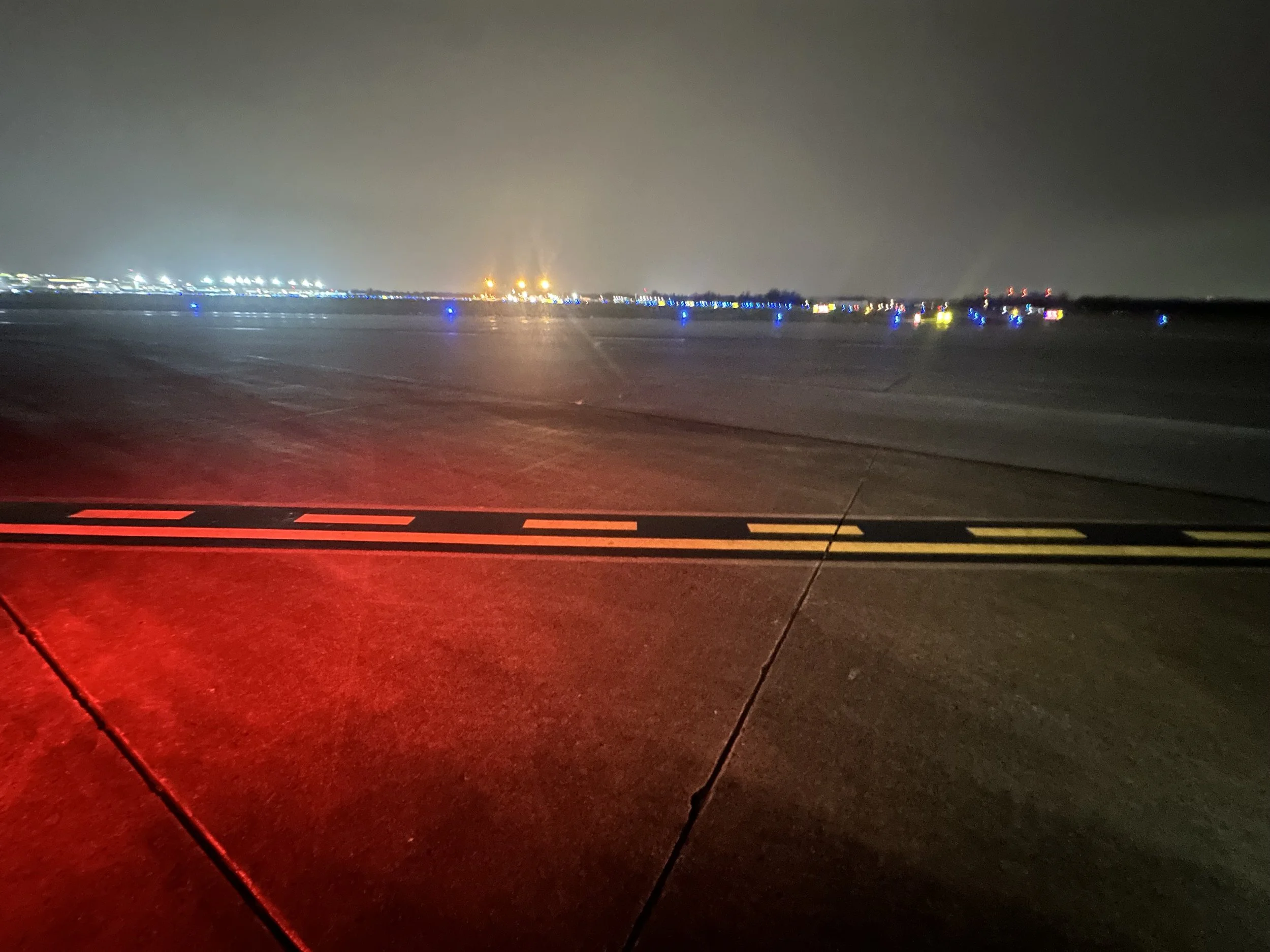
The One Marking You Must Understand
This is the most important boundary line on the entire airfield for any driver.
It is a set of yellow lines that separates the non movement area from the movement area. It looks like one solid line and one dashed line. The solid line faces the non movement area. The dashed line faces the movement area.
And this rule is simple.
You may not cross from the solid line side into the dashed line side without permission from Ground.
That line is the difference between needing no radio calls and needing perfect radio phraseology.
That line decides who controls the area you are driving into.
That line is the first thing we talk about when training new ops staff.
Once you cross that line, you are now in air traffic control’s world.
Who We Talk To at CMH
And When We Talk To Them
We use three frequencies depending on what we are doing. Not all airports work this way, but this is CMH specific.
Clearance and Delivery
We only talk to Clearance and Delivery in two cases:
When we are closing a taxiway
When we are issuing a runway FICON
Clearance and Delivery at CMH helps ensure big airfield changes get coordinated and logged into the national system. If we are not doing one of those two things, we are not talking to Clearance.
Example phrase using real CMH geography:
“Columbus Clearance, Airport 7 is closing Taxiway Alpha between Alpha three and Alpha four.”
This is something we do often for maintenance, construction, or training.
Ground
Ground is our most common contact. Ninety percent of driving on the movement area goes through Ground.
We talk to Ground when we want to:
• Proceed onto a taxiway
• Drive along taxiways
• Cross a runway
• Move anywhere that is not an active runway
Ground owns the network of taxiways. If we want to step foot on Alpha, Bravo, Charlie, Delta, Echo, Foxtrot, Hotel, Juliet, or any of the connectors, we call Ground.
Here are CMH accurate examples:
Example 1:
Requesting permission to enter Taxiway Alpha from the cargo ramp:
“Columbus Ground, Airport 7 at the Southeast Cargo Ramp, request Taxiway Alpha.”
Tower
Tower owns the runways.
If we are going to be on a runway or inspecting a runway, we talk to Tower.
This includes:
• Entering the runway
• Driving the full length for inspection
• Responding to a wildlife strike on the runway
• Removing debris
• Closing or opening the runway after we coordinate with Clearance
A CMH accurate call might be:
“Tower, Airport 6 holding short of Runway Two Eight Left at Juliet, request to enter for inspection.”
Or if we are doing a full inspection from end to end:
“Tower, Airport 6 at Runway One Zero Right, request to inspect Runway One Zero Right full length.”
Once approved, we repeat the clearance word for word.
There is no guessing on a runway.
What We Say — And Why
The Anatomy of a Radio Call
Radio calls are not small talk. Every word matters, and every call follows a format.
Here’s how we train new team members to think about it when talking to Ground for permission to enter a taxiway. Think of it like a checklist. It always includes these four things:
Who you’re talking to
Who you are
Where you are
Where you want to go
Let’s walk through a real example using actual CMH locations.
Requesting Taxiway Alpha from the Cargo Ramp
Say I am parked on the Southeast Cargo Ramp and need to get out to Taxiway Alpha. My call would go like this:
“Columbus Ground, Airport 7 at the Southeast Cargo Ramp, request Taxiway Alpha.”
Now here’s what Ground might say back:
“Airport 7, proceed Taxiway Alpha, give way to all taxiing aircraft, hold short of Runway Two Eight Left.”
That is the official clearance. But here’s the most important part:
You must repeat everything they said that involves an instruction.
So I would respond with:
“Proceeding Taxiway Alpha, I will give way to all taxiing aircraft and hold short of Runway Two Eight Left.”
Now — and only now — am I legally and safely allowed to move onto Taxiway Alpha.
If I leave out part of the response, especially anything involving runways or aircraft, they will ask me to say it again. That is because the readback is what confirms we understand what is expected of us. It is how they verify that we are not going to drive into something we shouldn’t.
What It Feels Like in Real Time
Driving With Radios, Planes, and a Job To Do
Here is how a normal trip might go.
Step One
We are in the non movement area near the cargo ramp. We need to get to a wildlife call near Taxiway Delta. The moment we roll up to the movement non movement line at Alpha, we stop.
We call Ground:
“Columbus Ground, Airport 6 at the Southeast Cargo Ramp, request Taxiway Alpha to Delta.”
Ground approves and tells us to proceed.
Step Two
We follow the yellow centerline out toward Delta. As we approach the hold short line, we stop again. A plane is on short final. We wait a moment.
Once the plane lands, we call:
“Ground, Airport 6 holding short of Runway Two Eight Left at Delta, request to cross.”
After approval, we read it back and cross.
Step Three
If we are going onto the runway for an inspection, we switch to Tower and repeat the process all over again.
Every step is deliberate.
Every movement matters.
Every radio call keeps someone safe.
Why This Matters
This Is Leadership You Can See
Driving on the movement area teaches you discipline.
It teaches you communication.
It teaches you to slow down, listen well, and never assume.
Tower, Ground, Clearance, and Ops are all working as one team.
We trust their voice. They trust our driving. And together we keep CMH moving.
Why I’m doing this
Partly because people keep asking me, “What do you do?” and I want to be able to point to something that actually shows it.
But mostly?
Because I don’t want to forget what I’m learning.
This job is crazy. It’s complicated. It’s full of nuance. You can work here for twenty years and still not know everything. And I don’t want the lessons to slip past me just because I didn’t take five minutes to write them down.
So this is my version of capturing it.
One post at a time. One story at a time. One lesson at a time.
If you’ve ever wondered what happens behind the jet bridge, out past the taxiway lights, or behind those giant “AUTHORIZED PERSONNEL ONLY” doors… you’re in the right place.
Let’s get to work.